

Rusalka were beautiful leaf-clad Siren-like femmes fatales spirits of the lakes of the northern Slavs. They enticed men to their watery graves and tickled people to death. – The Oxford Companion to World Mythology (2005)
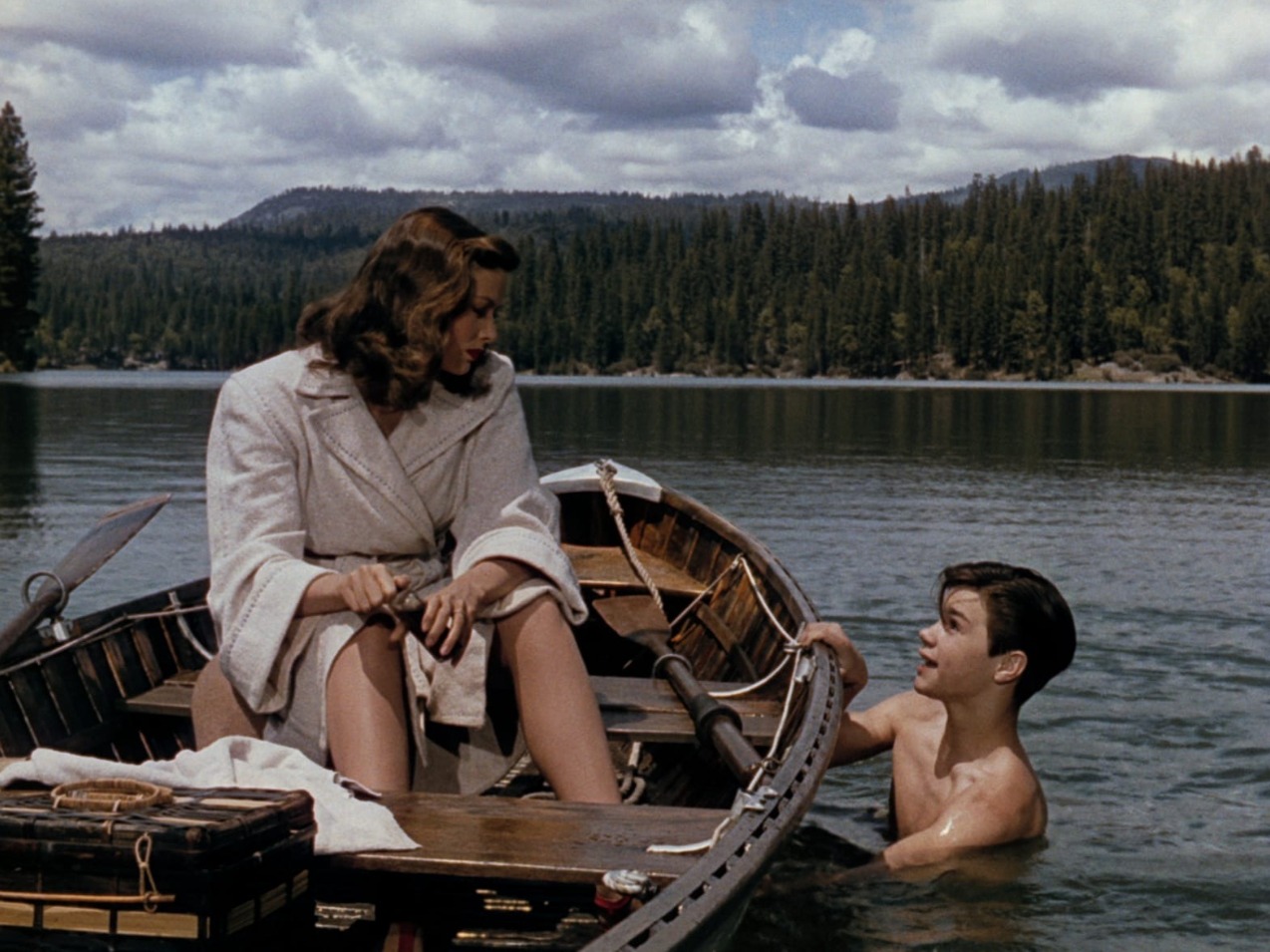
I once read that Francois Truffaut thought a critic must see a film at least three times before reviewing it, or else issue an apology to his readers. For at least half of my first viewing of Leave Her to Heaven, my impression was guilt-ridden boredom at such splendid cinematography and scenographic detail being dropped on the floor like fine china by staid direction and a shallow script. This unusual pairing of Technicolor and film noir is about the near-ruination of a novelist, Richard Harland, by the voraciously possessive woman he marries, Ellen (Gene Tierney), who takes a romantic interest in him because he resembles her recently deceased father. Ellen coldly destroys those who get between her and her husband. Danny, the writer's polio-suffering younger brother whom he dotes on, is drowned in a lake. Later on, she throws herself down a flight of stairs to abort her unborn child, believing that the pregnancy is distancing her from Richard. When Richard finally decides to leave her, she kills herself and frames him, along with her sister who loves him, for murder, to ensure that he never replaces her. Her ploy is unsuccessful but Richard is imprisoned for two years.
It was during this suicidal act in the last 15 minutes where I started to suspect a film much better than I initially thought. Before, I had been following the plot too materially, as a shocking story of domestic murder. From the shot above, where Richard strains to unclasp Ellen's just-deceased hand from his, not knowing she is about to frame him from the grave, I realized a much greater, metaphysical power to the film. It is about a love that is so obsessive it scorns the mortal world and desires to overcome death: Ellen destroys the living (brother-in-law, sister, the child inside her, Richard, even herself) to resurrect the dead (her father's image, her tie to Richard). The sibling of this film is called Vertigo (1958). Hitchcock's film is better, however, because of the source of this love that aims to cheat death. Scottie's obsession comes from the desire to revive a lover and a romance that died prematurely; a very human sentiment taken too far becomes ghoulish and ultimately self-defeating. On the other hand, Ellen’s obsession is founded in a Freudian gimmick, the so-called Electra Complex, and is manifested in extremely sensational acts of violence, which cheapens the affair by comparison. She's unrealistic on purpose, in fairness to the film, I just find this less interesting than Hitchcock's approach. As I alluded to in the beginning, Ellen should be understood as mythological, as Tierney's expressionistic performance affirms.

Understanding the film in this form, Stahl's mise-en-scene that seemed merely ornamental at first now carries an unmistakable weight of fatalism, ghostliness, and dread in every one of its meticulous constellations of light, colour, props, angles, and blocking.
Score: 3.5/4

No comments:
Post a Comment