Thursday, February 27, 2025

Leave Her to Heaven (1945)

Rusalka were beautiful leaf-clad Siren-like femmes fatales spirits of the lakes of the northern Slavs. They enticed men to their watery graves and tickled people to death. The Oxford Companion to World Mythology (2005)

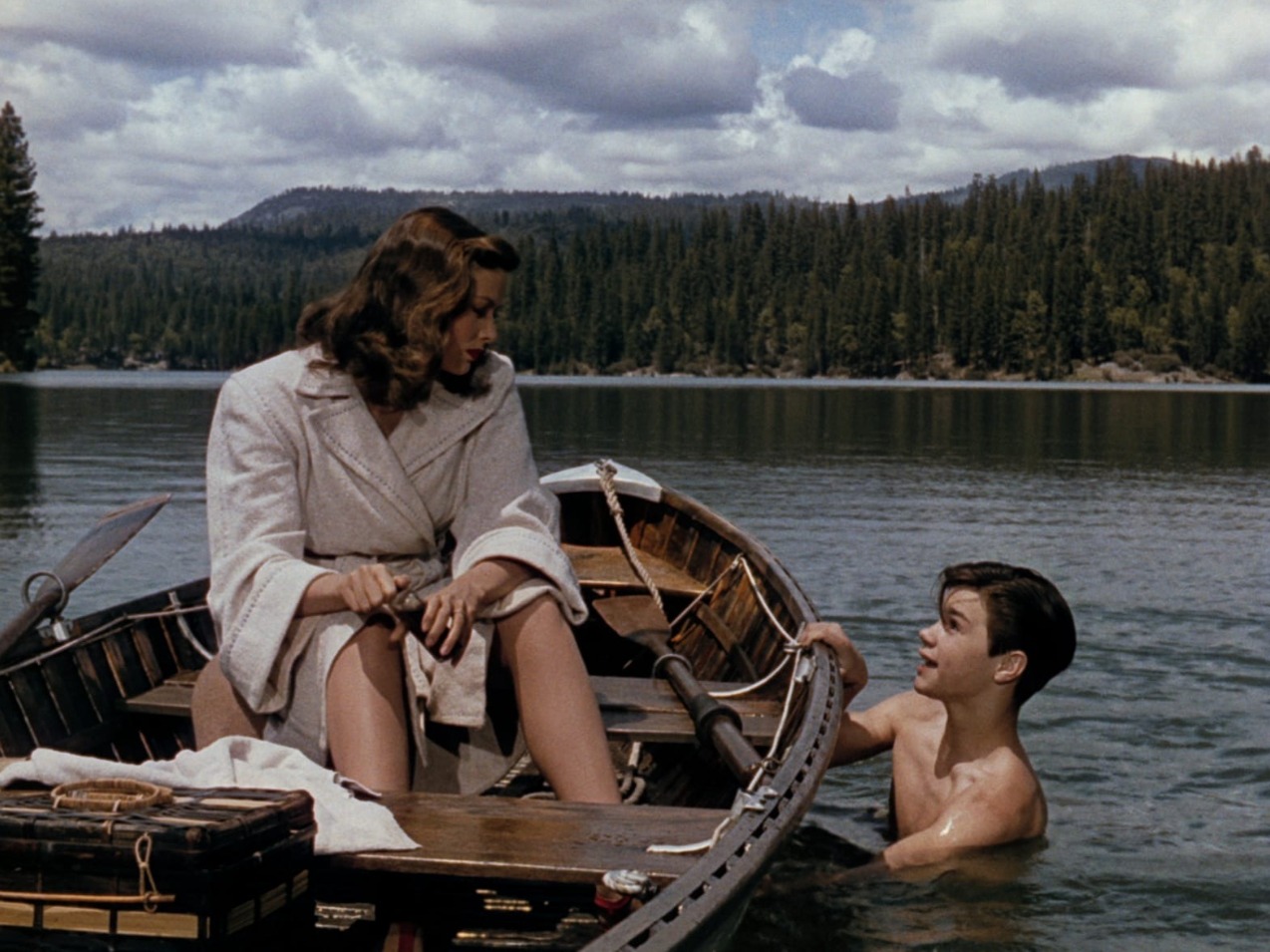
I once read that Francois Truffaut thought a critic must see a film at least three times before reviewing it, or else issue an apology to his readers. For at least half of my first viewing of Leave Her to Heaven, my impression was guilt-ridden boredom at such splendid cinematography and scenographic detail being dropped on the floor like fine china by staid direction and a shallow script. This unusual pairing of Technicolor and film noir is about the near-ruination of a novelist, Richard Harland, by the voraciously possessive woman he marries, Ellen (Gene Tierney), who takes a romantic interest in him because he resembles her recently deceased father. Ellen coldly destroys those who get between her and her husband. Danny, the writer's polio-suffering younger brother whom he dotes on, is drowned in a lake. Later on, she throws herself down a flight of stairs to abort her unborn child, believing that the pregnancy is distancing her from Richard. When Richard finally decides to leave her, she kills herself and frames him, along with her sister who loves him, for murder, to ensure that he never replaces her. Her ploy is unsuccessful but Richard is imprisoned for two years.

It was during this suicidal act in the last 15 minutes where I started to suspect a film much better than I initially thought. Before, I had been following the plot too materially, as a shocking story of domestic murder. From the shot above, where Richard strains to unclasp Ellen's just-deceased hand from his, not knowing she is about to frame him from the grave, I realized a much greater, metaphysical power to the film. It is about a love that is so obsessive it scorns the mortal world and desires to overcome death: Ellen destroys the living (brother-in-law, sister, the child inside her, Richard, even herself) to resurrect the dead (her father's image, her tie to Richard). The sibling of this film is called Vertigo (1958). Hitchcock's film is better, however, because of the source of this love that aims to cheat death. Scottie's obsession comes from the desire to revive a lover and a romance that died prematurely; a very human sentiment taken too far becomes ghoulish and ultimately self-defeating. On the other hand, Ellen’s obsession is founded in a Freudian gimmick, the so-called Electra Complex, and is manifested in extremely sensational acts of violence, which cheapens the affair by comparison. She's unrealistic on purpose, in fairness to the film, I just find this less interesting than Hitchcock's approach. As I alluded to in the beginning, Ellen should be understood as mythological, as Tierney's expressionistic performance affirms

Understanding the film in this form, Stahl's mise-en-scene that seemed merely ornamental at first now carries an unmistakable weight of fatalism, ghostliness, and dread in every one of its meticulous constellations of light, colour, props, angles, and blocking. 

Score: 3.5/4


Sunday, February 23, 2025

Eraserhead (1977): In a review of Lost Highway, the Brazilian film critic Bruno Andrade likened Lynch's films to "live television broadcasts of nightmares." By this I think he means that their naive spontaneity – exploding the viewers' assumed rules of genre, realism, narrative causation – doesn't allow the viewer a safe vantage to approach the films from; their disturbing images come from nowhere and vanish without clarification, as if they didn’t have an author carefully assembling them but were an inexorable transmission from someone's tormented unconscious.

This is, pending a viewing of Inland Empire, Lynch's most relentlessly bleak world: a monochromatic sealed chamber of misery, discomfort, and decay. The setting is a rundown industrial district of Philadelphia that possesses only vestiges of humanity (there are, I would say, a total of fifteen living souls seen in the whole film, and at least a third of them I struggle to call "human"). The sheepish protagonist, Henry Spencer, looks as if a science experiment blew up in his face and the shock was frozen into his exterior. He walks through this rusting wasteland on the way from his factory job to his ratty apartment building – the lobby is so deadly empty it feels as though all the air was sucked out into a space vacuum. His letterbox, which he reflexively checks, never has mail. The apartment is laden with needling details of poverty and disuse, so that it never ceases to feel discomforting: the room is cramped, the bed is moth-eaten, the radiator is loud, the space is dotted with mysterious piles of grass and dirt as if all the muck from outside is beginning to creep in. He visits his girlfriend Mary's house – his only companion, although their relationship is estranged – to meet her parents, where it is revealed that Mary has just given birth, even though Henry has not known her long enough for that to be possible. Indeed, this "baby" is not normal at all, and becomes a source of irritation and horror. 


I won’t spoil any more. All of this is to say that Eraserhead is the film of a young man with monstrous anxieties about adulthood: wageslavery, destitution, illness, alienation, loneliness, immobility. Lynch, a child of the 1950s, interpolates many motifs of media from his youth into a corrupted, post-nostalgic form: the aestheticization of the ‘atomic age’ (seen framed on Henry's wall, then re-emerging through the diseased “baby”), the Norman Rockwell vision of domestic life (his meeting with Mary's family), The Twilight Zone (the starlit opening, the black-and-white journalistic profile of an existentially doomed character). 

I think the film lacks the consistent inspiration needed to be really great. It’s constantly uncomfortable, but in ways that are not always artistic. In the middle especially, there are too many shots of gross, squelchy things; too much loud droning; too much colicky squealing hammering on the viewer’s lizard brain. In its good sections, though, Lynch proves an inimitable artist.

Score: 3.5/5

Thursday, February 20, 2025


In August 1944 the Home Army in Warsaw rose against the Nazis in hopes of liberating the capital in step with the Soviet military advance. In the events that followed and still breed controversy to this day, the Red Army halted its advance and allowed the Nazis to use their remaining forces to brutally suppress the rising and completely destroy the city. It was only on 17 January 1945 that the Red Army entered Warsaw and installed the provisional pro-Soviet government. – Worldmark Encyclopedia of the Nations (2007)

It carries an air of doom from its very beginning – title cards over Warsaw as a bombed-out wasteland, its burning building faces crumbling into clouds of dust, noiselessly, to tides of bombastic orchestral music. Hell in broad daylight. In the first real shot, the Polish resistance members we will follow for the rest of the film trudge across a hilltop as small silhouettes, then make a fatalistic zig-zag into the foreground of demented rubble and barbed wire which none of them will survive. It is the 56th day of the Uprising. It will end in a week. Most of them will not last a day.


In a 2004 "City Cinematheque" television program discussing the film, the Polish-American guest interviewee says that, although he was born three years after the Warsaw Uprising, he feels as though he can personally recall it, such was its lasting impact on the nation. Perhaps it then does not surprise one to learn that the director Andrzej Wajda was a Polish resistance fighter in the Uprising himself, along with many of the crew, who hid in the same Warsaw sewer tunnels as the characters 12 years prior. The film's cast is not a band of soldiers but more appropriately a cross-section of Poland: combatants and non-combatants, men and women, lovers of varying kinds, even a pianist, five decades before Polanski's.


The remnants of this dishevelled resistance group, realizing they can no longer hold out above-ground, retreat into the sewer, a twisting brick labyrinth from which none of them successfully emerge; all either die or are captured. The pianist eventually goes mad in this inescapable subterranean hell and wanders off into oblivion playing an ocarina, like the lyre-playing Orpheus who cannot lead Eurydice back out of Hades once she has gone there. Wajda understands that Poland is flanked by the Nazis and the Holocaust on one side, and Stalinist Communism on the other, and resolves the situation as hopeless. Earlier in the film, the Polish fighters celebrate disabling an attacking German tank with their last rocket, until two little remote-control tanks emerge from behind its hull, like Russian dolls.


Wajda brings a dirgeful tone to wartime defeat that is inconceivable in North American or English cinema. Even in the few Hollywood war films about defeat, such as John Ford's lousy They Were Expendable (1945), there is a glory in the losers' sacrifice, accompanied by a nod outside of the fiction to an avenging victory that will eventually come. In Kanal there hardly seems to be a Poland left to martyr oneself for. Our sole glimpse into the world outside this struggle is the number of the pianist's wife and daughter dialled on the phone – 4-02-18 – who are taken away by the Germans while the pianist is on the line, frozen in the corner of a besieged apartment. 


Score 3/5.


Tuesday, February 18, 2025


Meek's Cutoff
 (2011): A rare instance of that endangered 21st-century species, the Western. Kelly Reichardt did not naively try to dip into the same river twice by reviving the outdated classical Western (Costner), nor did she throw the baby out with the bath water through nihilistic postmodern pastiche (Coens). Her film largely forgoes Western myth, in fact, and aims to plunge directly into history itself, with earthy, intensely naturalistic images to bring out the 'soul' of 19th-century frontier existence long before the cinema was even a speck on the horizon. In this sense, the first comparison that came to mind while watching was the grim historical dioramas of Robert Eggers, although the much more flattering precedent would be Herzog's Aguirre, Der Zorn Gottes (1972), which also happens to be a film about a doomed journey into the wilderness of the Americas. 

The story is thread-bare even for Westerns: in 1845, a small wagon train of three men and their wives (and one child) is being led by a guide on a supposed shortcut – a cutoff – forking from the Oregon Trail to the settlement of Willamette Valley, where "Civilization is taking hold" in an otherwise barren wilderness. Problem is, the blustery, Native-hating mountain man leading this journey, Meek, seems to have no clue where he's going, yet he won't admit it. Halfway through the film, Meek's archetypal inverse, a Native American, appears and is permitted by the frustrated party to take over from Meek as their guide. However, the language barrier renders his destination ambiguous to the travellers, and they still don't know if they're lost. 

This vague narrative framework gives way to a "slice of life" audio-visual experience of a past fraught with primordial terror at the unknown. The film's two formal motifs that are most criticized in reviews – a tendency to shoot conversations from afar, with the confused travellers' words slightly dissipating in volume across the frontier space to reach us; and the almost illegibly dark nighttime camp scenes, where they pray and worry about their survival – are supposed to manifest these unsophisticated people's anxiety in the face of an endless, enveloping outdoors, with 19th-century Christian anxieties of demons and murderous Indians and starvation swimming around their heads. It is a dirty, unromantic existence, filmed not in 'scope, usually a given for every post-1950s Western, but in a cloistered academy aspect ratio, emulating the parochial headspace of Reichardt's wanderers. In an early scene, one of them is reading the Book of Genesis aloud, comforting themselves by earnestly equating their new start to Adam and Eve. You get this thrilling sense of the curiosity, dread, and excitement these God-fearing people must have felt on the precipice of this "new" world, this new Eden – a profoundly religious way of experiencing the world that we no longer possess.

The film hampers itself a bit in the final third, with its rather boring resolutions of tensions built up prior. The climactic scene depicted on the poster, of Michelle Williams' character pointing a rifle at Meek to protect their Native American prisoner from execution, is too politically correct to convincingly possess the historic gravity of crossing the line that it's trying to. What this frontier woman in 1845 feels in that moment – anger at Meek's racist machismo and sympathy for the oppressed figure of the Native American – is the same as what the 21st-century liberal spectator feels; there are no contradictions between character and audience to make this moment of proto-feminist/proto-anti-racist conflict interesting and authentic. It is a betrayal of what Reichardt tries to do for most of the film: challenge you to imagine a worldview that doesn't exist anymore. Also tired is the film's ambiguous arboreal final symbol, a double-whammy of feeling like both a cliché and a cop-out. What one remembers about Reichardt's film days later is the visceral impact of its images and sounds from another time, not this stuff.

Score: 3/5

Friday, February 14, 2025


The Purple Rose of Cairo (1985): Allen evokes hard times, 1935, when the movie house was a repository of far-off dreams for the hopeless urban shuffler: a brown Jersey factory town, waitress-housewife with a deadbeat husband, mean diner patrons in the morning and beatings in the night. On her fifth pilgrimage of the week to watch Gil Shepherd in The Purple Rose of Cairo, Shepherd’s character notices her in the audience and breaks off the picture to enter the real world and take her away. Baxter soon hears word of this on the West Coast and comes to take his creation back and return him to fiction, in a strange scenario that bittersweetly sums up the seduction and folly of Hollywood “fandom.” 

The concept has precedents going back to Sunset Boulevard and especially the Twilight Zone episode “The 16-Millimetre Shrine,” where after seeing a has-been actress unsuccessfully try to make a comeback in Hollywood, the actress’s agent enters her living room to find that she has finally vanished into the celluloid of one of her old home movies, blowing a kiss to her audience before receding into fiction forever. Allen analyzes this type of escapist fantasy, which Rod Serling rendered chillingly, from an angle that is more romantic and light but refuses any mawkish conclusions nevertheless. 

Allen’s mise-en-scene, which was pretentious in the other films I’ve seen (ManhattanA Rainy Day in New York), is of a refreshingly modest intelligence here — one remembers the image of Cecilia’s husband sheepishly standing behind his bedroom door after being caught cheating, or the use of the town’s vacant theme park, closed-down and overgrown from the Depression, as a backdrop for the film’s romance. In its best moments, Allen achieves a ghostly beauty in this fable about the flittering illusions of parasocial relationships with art and artists. 

Score: 3.5/5


Intruder in the Dust (1949): A handsome, respectable product of Hollywood filmmaking, which is a branding you probably do not want for a film about a Mississipi mob lynching and the American South’s heart of darkness. A land-owning black man (the intriguingly gnomic Juano Hernandez), whose indifference to racial hierarchy baffles and enrages his white neighbours, is sentenced to hang for the murder of a sawmill worker. The townspeople ‘tailgate’ the execution like a kind of carnival attraction, parking their cars outside of the jailhouse in droves for a Summer's day out. The catch is that the man is being framed, the murdered’s brother did it to steal lumber from his sawmill, and it takes a handful of sympathetic townspeople fishing the corpse out of a remote quicksand pit where the Cain hid him to reveal this ugly truth and stop the madness.


The film carries various markers of studio ‘prestige’ and artistic Importance: the socially conscious subject matter, the authentic location-filming in Mississipi, the “shocking” utterances of the N-word (permitted for the first time in a Hollywood film since pre-Code days), and the absence of a musical soundtrack (a highly welcome absence, jangly orchestral music being the absolute bane of Old Hollywood cinema that every cinephile merely comes to tolerate through experience). Clarence Brown isn’t able to coordinate all of this expenditure into something really interesting, it’s rather empty and boring, but it has a very fine pictorial sense (Brown started in silent films, always a tell) that makes you wonder the next day if it’s better than you’re giving it credit for. 


Score: 2.5/5

Tuesday, February 11, 2025

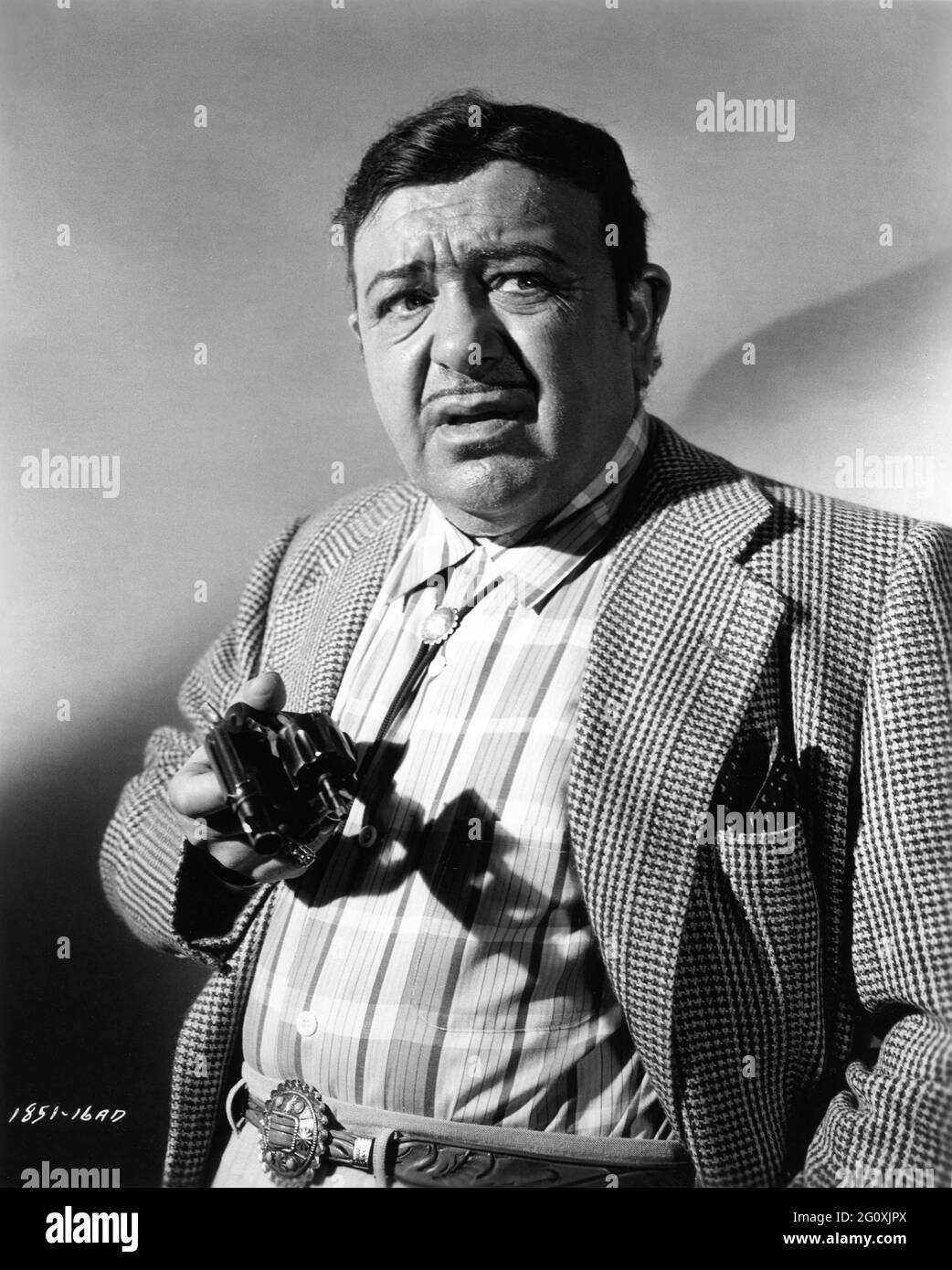
The leading citizen of a U.S.-Mexico border town has a timebomb slipped into his convertible’s trunk Stateside and explodes three minutes later in Mexico. Employed on the case of his murder is Vargas (Charlton Heston), a prosecutor from Mexico City on honeymoon with his American wife (Janet Leigh); and from the other side is Captain Quinlan (Orson Welles), the bumptious American police chief, a crusty and unscrupulous veteran who solves cases on the whims of his game leg that twitches when he feels a lead. From the two men’s first interaction filmed in titanic low-angle close-ups, an antagonism is understood. Vargas catches Quinlan framing a suspect for the murder, and from here the situation quickly deteriorates into such a nightmarish shadow game of death and manipulation that this initial crime plot is quite forgotten for most of the film. It appears that Welles, making his first (and final) Hollywood film in 10 years, has learned to abandon the banalities of genre that made The Stranger (1946) seem like a misstep to film buffs, and prefers to unfold an exercise in style. 


With that said, revisiting it days after The Stranger (1946), the films' premises are remarkably similar: the overthrow of a corrupt tyrant embedded in a community by an innocent and pure interloper. In both films Welles tries to complicate this dynamic in different ways, more successfully so in the latter. In The Stranger, the villain is an unequivocal monster masquerading as the handsome and well-liked bastion of a small American town, while the hero is rather squat and innocuous. The villain in Touch of Evil both looks and acts monstrous, but the famous joke at the story's end is that the man he framed was indeed guilty of the crime, and, by implication, so were his prior frame-jobs. All of Vargas' exertions in exposing Quinlan, right as he may have been to do so, were a denial of the truth while implicating his wife, Susie, in an unceasing nightmare of kidnapping and torture by Quinlan and the Grandis as a means of blackmailing her clueless husband.


My favourite poster image for the film is the "Restored Version"'s original DVD cover, which is a little bit vulgar, like most DVD covers, but provides an enjoyably moody interpretation of the film, with the giant head of Quinlan looming over his victims under the mystical blue sheen of a crystal ball. This terrible, rusting border town Welles creates is the physical soul of Quinlan, that burbling, limping mess, so corpulent he becomes something mythic, something more than human, in the pit of whose stomach lies the infinite annals of the police file room, the endless pumping of serried oil rigs, and the waves of beached garbage built-up on the dirty river bank that Quinlan's bloating, floating corpse becomes another piece of.

This is a film of paranoia, manifested in its propensity for long takes that connects the mendacity of its characters into a shared, anxious atmosphere: the view of a shoe box in a bathtub, like forensic evidence, minutes before it is planted with dynamite to frame a man for murder; tuxedoed police chiefs and attorneys gossiping about Vargas in a packed tin-can elevator while he takes the stairs. I was reminded of Polanski, whose filmography could be summed up by the title of this film.

Score: 4/5


Sunday, February 9, 2025


The most beautiful image I remember from visiting New York, a city I'm not particularly fond of, was something I didn't even physically see. It was conjured in my head, from the claim of a tour guide while walking through Manhattan's Chinatown, that people in the 20th century were born, lived and died within the confines of that neighbourhood without venturing outside, or using any language besides Cantonese. That mental film repeatedly popped into my head while watching Year of the Dragon (1985), this masterpiece where New York's Chinatown is "not the Bronx or Brooklyn, it's not even New York," as the head of the town's mafia brags. A greasy three-room tenement where fugitive gang youths recover from bullet wounds in the bathroom; gang war casualties submerged in a stygian soy-bean basement, filled with elderly workers who have slaved away in its depths for four decades; a Chinese New Year's parade, which the film launches us into from the opening credits, a street opera of confetti and firecrackers exploding in thin air amidst a sea of costumed dancers and drummers; this is the hermetic world of a people that have sustained themselves for thousands of years. The NYPD officers on-duty there are never called.


This film has been a favourite of mine since high school for two primary reasons: the intensity of Mickey Rourke’s acting as a quixotic, heavily flawed, police captain; and Michael Cimino’s unbelievable mise-en-scene, which achieves a dense, tactile richness in detail – in the sets, the light, the colours, the framing, the camera movement – that I genuinely have not seen matched in any American film except Cimino’s others. This was previously my rationale for loving the film; it has taken me until recently to grasp its significance as a complete work.

Similarly to Welles with The Stranger (1946), we have a case of a director forced, by certain exigencies of maintaining a Hollywood reputation, to adapt to a smaller, safer mode of film than they were creating before – in Cimino's case, reclining from the historical epic to the police film following the financial flop of Heaven's Gate (1980). But even moreso than with Welles, Cimino is such a genius that this shrinkage in the form's potential hardly seems to matter at all; it's the most expansive, transcendent police film I have ever seen. 


The story precedes from a common theme of crime films, the revelation of a kinship between the cop and the criminal: Stanley White (Mickey Rourke), a patriotic, racist soldier of the Vietnam War and now of the police, who foresakes his personal life and breaks the city's corrupt "arrangement" with Chinatown's organized crime families to destroy their operations; against Joey Tai (John Lone), the ambitious young turk of the Chinatown mob, who assassinates his elders and foregoes their traditional dealings with the Italian mob to increase his profits. There's obviously a dualism in both being ruthless iconoclastic members of their respective group, yes, but more importantly, their parallelism manifests in the shared desire to conquer the vertigo of the world's vastness – in space, in history, in cultures. White is trying to dig at something, scouring books of Chinese railroad work history in America, uncovering corpses in soybean basements, for the sake of this ridiculous ideal of "winning the war in Chinatown," the victory over a non-integrating diaspora he can't understand, the victory over the wound of a war he can't understand; transcending his suspension in history. This is the beautiful surrealism underlying the scenes in his ally and lover Tracy's (Ariane Koizumi) apartment, which Cimino described in an interview as a "magical Chinese kingdom": the skyline of Brooklyn, with cars cometing across the Brooklyn Bridge as orbs of light, stretches out before him like God looking over the earth; it represents both the transcendance White is trying to achieve, and the alienation and harm that his yearning causes to his wife, his friends, Tracy, and himself.


David Lean, particularly The Bridge on the River Kwai (1957), clearly evoked

“As above, so below”: Joey Tai seeks the capitalist sublime in the mountainous jungle of Burma, clothed in Khaki’s like one of David Lean’s romantic adventurers (Lawrence of Arabia stands among Cimino’s ten favourite films). He seeks to surpass the ossified traditions of his predecessors, to found a global empire. In the end, both he and White fail to achieve their aims, are disgraced, and removed from their commands. It is certainly no accident that their final deathly confrontation takes place on railroad tracks, that monument to China’s hidden painful history in America, a failure of the two men against the oblivion of history. 


A good definition of a genius is someone who does not depend on any system but his own imagination. Cimino, an alchemist who turned a generic police story into tragic myth spanning the ends of the earth and of human history, fits this definition quite perfectly. 


In a magnificent article by the French critic Serge Daney on the film, he makes what struck me as a brilliant observation in the first sentence, that Cimino's big artistic preoccupation in this film seems to be asking, "what is near, and what is far away?" Cimino's Chinatown is a very fantastical place, a kind of theme park infused with millennia of history from thousands of miles away, and yet it is located in the same city as the quiet Polish district White comes home to every night. Inversely, the 'war in peacetime' that Stanley White wants to wage against the Chinese mafia, whose heroin imports trace all the way to paramilitary forces in the Burmese mountains, is in his mind a continuation of the Vietnam War, a kind of nonsense-rationale itself traced back to an overseas wound 15 years prior. "There, I never saw the goddamn enemy. Here, they're right in front of my eyes!" White tells his boss; it's not a pithy "action movie" line, its a credo of Cimino's cinema. "How," Daney asks, "do things go about reaching us from the ends of the earth?" The Deer Hunter (1979) is all about this, an odyssey to Vietnam and back again that seems to infect the characters' minds, and never lets go of them.


At a point in the middle of the film, we move from following White, whose wife has just been murdered by hitmen ordered from Joey Tai, to Tai's 'business' exploits in South-East Asia, bringing with him the decapitated head of a rival gang leader to strike a heroin deal with his supplier. From that shot, we cut to the head of a religious icon watching over a Catholic funeral for White's wife in New York. Into this "white" space of mourning enters, completely unexpectedly, a Chinese soybean basement worker Stanley met in Chinatown earlier in the film. Somehow he heard the news, and arrived to pay his respects. It's a moment reminiscent of the miraculous ending of Capra's It's a Wonderful Life (1946) where the universe seems to converge on the hero in a climax of feeling. In Daney's words, Cimino's cinema in moments like these are "movies with ever-wider concentric circles, where the threads connecting what’s close and what’s far are woven before our eyes, where the whole world communicates with itself." 


Score: 4.5/5

Saturday, February 8, 2025


Do you know the quotation, Emerson: 'Commit a crime, and the earth is made of glass'? – a nameless partygoer, The Stranger (1946)

It's a bright, guilty world. – Michael O'Hara, The Lady From Shanghai (1947)


Agent Wilson of the Allied War Crimes Commission has a gambit to find a runaway Nazi: leave his lackey's cell door open one morning, and follow where he goes. The lackey interprets his freedom as a miracle, converts, and tracks down his master to a small town in the state of "Konn-Ech-Tee-Küt" to save his soul. 

Small-town America has made a pleasant abode for the fugitive, he teaches German history to the boys at the local prep school and is engaged to the daughter of a Supreme Court Justice. In his spare time he services the town church clock, and is often found crouched in the bell-fry like a nesting eagle.

The lackey has led the police to the Wanted Man, so naturally the lackey must be killed. His body is covered with a pile of leaves and left sitting in a nearby forest where the professor's students play Paper chase.

Thus goes the film's prologue, and the whole essence of the matter. 

This excellent film has the unfortunate reputation of an impersonal "assignment" for Welles, where his artistic sensibilities were drowned out to show Hollywood that he could direct a conventional picture like everyone else. It's an overstated criticism that only has serious application to the film's detective plot, which is uncharacteristically generic. The mise-en-scene that Welles has recourse to for this story, conversely, is inspired from beginning to end, despite being less extravagant and disjunctive than in his more renowned works. The darkly humorous evocation of a sleepy autumnal town with a "touch of evil" running through it is prodigiously executed, and with a much more mobile camera than the film's detractors make it seem. It's only a matter of trading one perfect style for another.

The two main performances – Welles as Franz Kindler/Charles Rankin and Loretta Young as his deceived wife – are extremely satisfying. I need only link this scene for proof. Edward G. Robinson as the Nazi hunter receives an indomitable portrait for the film's final shot. When filming, he would only let Welles photograph him on the "good side" of his face...whichever side that is. This was his only collaboration with Welles, but he is spiritually revived as the self-conscious gangster "Uncle" Joe Grandi in Touch of Evil (1958).

Score: 4/5 :)

Wednesday, February 5, 2025


A very bad mood to see a film in: I arrived at the theatre, glowing, because I thought I was seeing Rebel Without a Cause (1955); I had gotten the date wrong. Ray's film was yesterday, they were showing George Stevens instead. Black & white has never seemed like such an inferior filming process as after that reversal. 

Stevens, a man with more Oscars for directing than Alfred Hitchcock, Howard Hawks, Orson Welles, Fritz Lang, Raoul Walsh, Ida Lupino, Samuel Fuller, and Nicholas Ray combined, is a filmmaker that none of the people whose opinions on film I value seem to value. His name carries gilded-fireplace reverence among old American men and not really any other World demographic. He is the ultimate AFI-core director. 

His career makes for a good biographer's blurb. At 13, he moved with his parents to Los Angeles and was immediately forced to drop out of school, as if from his entry into California it was fated that the classroom would have no more use for him, his life would be devoted to the cinema. The first half of his Hollywood career was spent directing comedies and musicals, passing through a museum of legendary Hollywood duos – Laurel and Hardy, Fred Astaire and Ginger Rogers, Cary Grant and Katherine Hepburn. When the war started, he joined the Signal Corps and filmed invaluable footage of D-Day, the liberation of Paris, the Battle of the Bulge, and the concentration camps. It was after this latter discovery that he quit the comedies and musicals upon returning to Hollywood, and devoted himself to dramas – portentous, ambitious, occasionally elephantine (Giant, The Diary of Anne Frank, The Greatest Story Ever Told). This second phase of seriousness, which is what most of his champions (and critics) now remember, was inaugurated by A Place In the Sun (1951), a tragic love story adapted from Theodore Dreiser's famous 1925 novel An American Tragedy, about an ambitious, self-educated young man (Montgomery Clift) who wants to abandon his pregnant working-class girlfriend (Shelley Winters) for a rich socialite he has fallen in love with (Elizabeth Taylor).

George Eastman (Clift), Angela Vickers (Taylor). Good names.

I've limned George Stevens' life not because of the strangely dark parallel between himself and George Eastman, the Clift character, but rather to illustrate that Stevens was a born maverick. His style reflects his insistently ambitious personality in a way that is in brief snatches brilliant, often watchable, and occasionally embarrassing. In virtually every set-up there is the sense of the dare, of the burning will to invent something original that will make a scene jump off the screen and lodge itself in the public's memory. But Stevens's reach as a director exceeds his grasp: he does not have the stylistic vision of a John Ford, in which the fictional world feels perfectly, effortlessly integrated with the mise-en-scene; Steven's style is based on a heterogeneous bag of tricks that has the consequence of the fictional world never quite feeling convincing. The shadow hand of a director labouring for art can always be sensed. Take for example the first 70 seconds of this scene (spoiler warning for link): the sudden presence of a Wizard of Oz tornado wind blowing their clothes, hair, and the pages of the registry book to symbolize "fate," which is magically about 50% more pronounced in the shots you can tell were filmed on a sound stage. It is exciting and a little bit false at the same time.

The director of the device, the trick up his sleeve – here, glittering water droplets judiciously planted on Angela's conveniently exposed back.

The experience of watching the film is therefore a bit like being a talent show judge. Every scene Stevens is going to bring in a new trick, and it may be exquisite (this dolly shot during George and Angela's first real meeting, where you think the camera will stop politely outside the two sets of pillars, but it continues to squeeze through, almost miraculously) or tawdry (in the window of George's apartment there is a flashing neon sign, "VICKERS," Angela's industrialist family name). 

The story also becomes long in the tooth in the last third, hammering on ideas that any decent viewer had already picked up on. There is one of the worst third-act cliches, the courtroom sequence.

Stevens and I met like two ships passing in the night, but a Taylor-Clift love affair did not begin; frankly, the film affirmed the misgivings of critics I respect, but it has a likeable brio.

Monday, February 3, 2025

The highest rated film on Letterboxd by the Greek maestro of actors and theatre, Elia Kazan. My only run-in with the director previously has been On the Waterfront (1954), which I remember liking a lot but didn't really stick with me besides this famous pile-driver, so impactful it generated Scorsese's only great film and has automatically cemented Kazan in my head as a great director. In A Face in the Crowd (1957), the acting is similarly impressive, but unfortunately, Kazan decided to make a prototype of that yawn-inducing genre, the "prophetic social/political comment." Making a film in such a small mode leaves little room for beauty, only "the message," which in my opinion is better left to the field of journalism.

In this story of the dishonest country bumpkin Larry "Lonesome" Rhodes (Andy Griffith), who captures the hearts and minds of America by simply being an idiot and refusing to apologize for being an idiot ("Trump!" yes, okay, we know), the audience is always afforded a nice elevated platform to look down on this fool and smirkingly shake their heads in comfortable disapproval. The salt in the wound is the moralizing, above-it-all journalist played by Walter Matthau, the one character who sees through him and smugly repeats the film's themes to us, not even letting us take pleasure in this drama of otherwise detestable characters screwing eachother over. Kazan's competency, which produces a few good moments of trashiness, particularly when "Lonesome" is enchanted by an adoring high school girl's baton twirling at a parade, places the film a tier above its incredibly shrill '70s cousin, Network (1976). 

Score: 2.5/5 – I am completely unsurprised that Spike Lee loves this film.